Bolivia Blue Sodalite
Origin: Bolivian Andes (around 3,800 meters above sea level)
Material Type: Sodalite-bearing ornamental stone (commercially marketed as Blue Sodalite Marble or Blue Sodalite Granite)
Color & Appearance
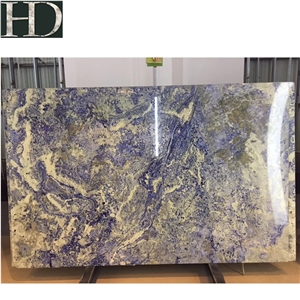
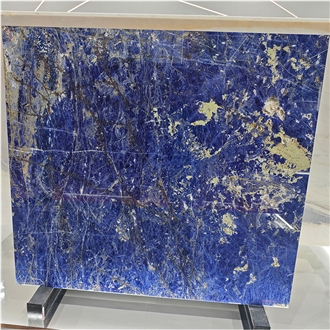
Bolivia Blue Sodalite features an intense cobalt-blue to royal-blue background, dramatically crossed by icy white to pale-grey calcite veins. Occasional dark grey and black mineral intrusions add contrast and depth, creating a distinctive and luxurious appearance. Its strong blue coloration and striking veining make it a rare, high-end decorative natural stone.
Texture & Pattern
- Dense, compact, predominantly massive crystalline texture.
- Irregular white and light-grey veins form contrasting networks across the blue background.
- Patterns may include sweeping veins, cloudy patches and darker mineral inclusions.
- Natural variation in blue intensity and veining occurs from slab to slab.
Geological & Mineralogical Characteristics
Sodalite is a sodium-rich feldspathoid mineral, not a feldspar. Bolivia Blue Sodalite is an ornamental rock containing sodalite together with associated minerals. It is commercially sold as marble or granite, but these names do not accurately describe its principal mineralogical identity.
The well-known Cerro Sapo deposit is located in the Cochabamba region of Bolivia. The material is associated with alkaline igneous rocks and carbonate-rich mineral assemblages.
Technical Characteristics & Test Results
The following are indicative commercial reference values, not a verified laboratory report for every variety or quarry lot.
- Water Absorption: Less than 1.0%
- Density: 2,270–2,310 kg/m³
- Flexural Strength: 45–60 MPa
- Compressive Strength: 80–100 MPa
Actual performance should be confirmed with a test report for the selected material.
Hardness
Mohs Hardness: 5.5–6 (typical for sodalite)
Sodalite is relatively hard but can be more vulnerable to scratching and impact damage than many conventional granites.
Mineralogical Composition (% by Weight)
The exact mineral percentages of commercial Bolivia Blue Sodalite are not established without a representative mineralogical analysis. The material may contain:
- Sodalite – principal blue mineral
- Calcite – commonly present in white veins
- Ankerite and other carbonate minerals
- Barite and other associated minerals
Chemical Composition (% by Weight)
The ideal chemical formula of sodalite is Na₈Al₆Si₆O₂₄Cl₂. Its approximate theoretical oxide-equivalent composition is:
- Na₂O: 25.6
- Al₂O₃: 31.6
- SiO₂: 37.2
- Cl: 7.3
These figures describe ideal sodalite, not the complete commercial stone. Calcite, ankerite and other inclusions can significantly change the bulk chemical composition.
Usage
Suitable for luxury interior applications, including:
- Kitchen countertops and islands
- Bathroom vanity tops and wall cladding
- Feature walls and decorative panels
- Interior flooring in low- to moderate-traffic areas
- Reception desks and bar counters
- Furniture, tabletops and decorative objects
- Backlit decorative installations where slab translucency permits
Maintenance
Use a pH-neutral stone cleaner and a soft cloth for routine cleaning. Avoid acidic products, vinegar, lemon-based cleaners and abrasive materials. A suitable penetrating sealer may help reduce staining, particularly where carbonate veins are present. Wipe spills promptly and use cutting boards and protective mats on countertops. Test cleaning and sealing products on a small, inconspicuous area first.


 Bolivia

 10YR

 China

 Italy






 Turkey



 Spain

 India


